Why PVC Matters in Europe
Polyvinyl chloride (PVC or vinyl) is one of Europe’s most widely used and versatile materials. It supports essential applications in construction, healthcare, energy, water management, communications and many other areas of everyday life.
From pipes, windows and cables to medical devices, flooring, roofing membranes and technical components, PVC helps deliver durable, affordable and reliable solutions across society. It also supports downstream industries such as mobility, food production, sport and leisure, where performance and adaptability are essential.
Through VinylPlus, the European PVC value chain is working to improve the sustainability and circularity of PVC products, while supporting Europe’s wider objectives for resilience, competitiveness and resource efficiency.
A Material Supporting a Resilient Europe
PVC supports essential sectors across Europe. Its combination of durability, versatility, affordability and recyclability makes it suitable for long-life applications that society depends on every day.
Building and Construction
PVC is the most used polymer in durable building and construction products such as windows, pipes, cables, flooring, wall coverings, celings and roofing membranes. These applications support long service life, affordability and resource efficiency.
Healthcare
PVC is used in essential medical applications such as tubing, oxygen masks and blood bags, where performance, flexibility, transparency and reliability are critical.
Water Resilience
PVC supports Europe’s water resilience needs through durable applications used in drinking water supply, wastewater management, drainage, irrigation, and other essential systems.
Energy and Decarbonisation
PVC contributes to energy systems through cables, profiles, roofing membranes with solar power, wind energy components, biogas infrastructure and applications being explored for hydrogen distribution.
PVC in Numbers
PVC or vinyl is part of a broad European industrial value chain, from raw material production and manufacturing to conversion, use, collection and recycling.
6,100 companies
Across the European PVC industry.
180,000 employees
Supporting manufacturing, conversion, recycling and related activities.
€45 billion turnover
Generated by the European PVC industry.
10.3 million tonnes recycled
PVC recycled through VinylPlus since 2000.
From Manufacturing to Recycling
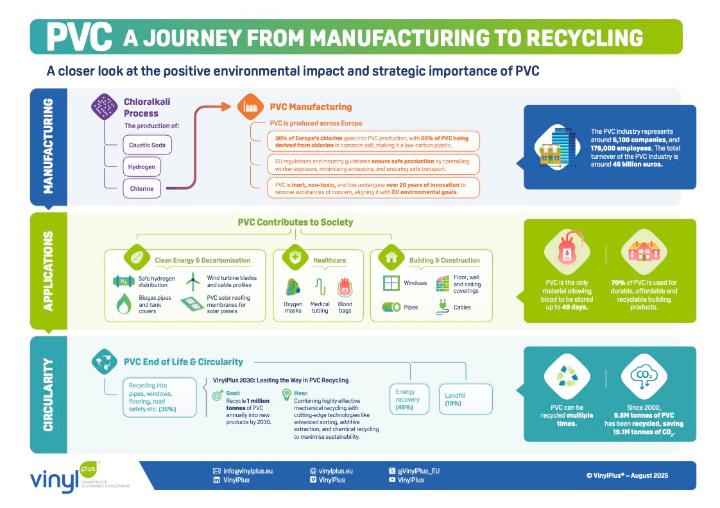
PVC’s contribution to Europe can be understood across its full lifecycle: safe and regulated production, essential applications, long service life, collection and recycling.
PVC is produced across Europe and is an integral part of the chlor-alkali process, which also produces chlorine, caustic soda, and hydrogen. A significant share of Europe’s chlorine goes into PVC production, while over half of PVC is derived from chlorine in common salt.
At end of life, PVC can be recycled into new products through mechanical recycling, while advanced sorting and recycling technologies are being developed to complement existing systems. Since 2000, more than 9.5 million tonnes of PVC have been recycled in Europe through VinylPlus.
Explore Vinyl in Everyday Life
PVC or vinyl is often hidden in plain sight. The Vinyl & You interactive map shows how vinyl contributes to everyday life across buildings, healthcare, energy, water management, leisure and other applications.