Competitiveness
A competitive European PVC value chain is essential for Europe’s industrial resilience, circular economy and long-term sustainability ambitions.
PVC, or vinyl, is deeply embedded in European manufacturing, construction, infrastructure, healthcare and other essential sectors. It is used in long-life products such as pipes, window profiles, cables, flooring, roofing membranes, medical devices, packaging, automotive components and other technical applications.
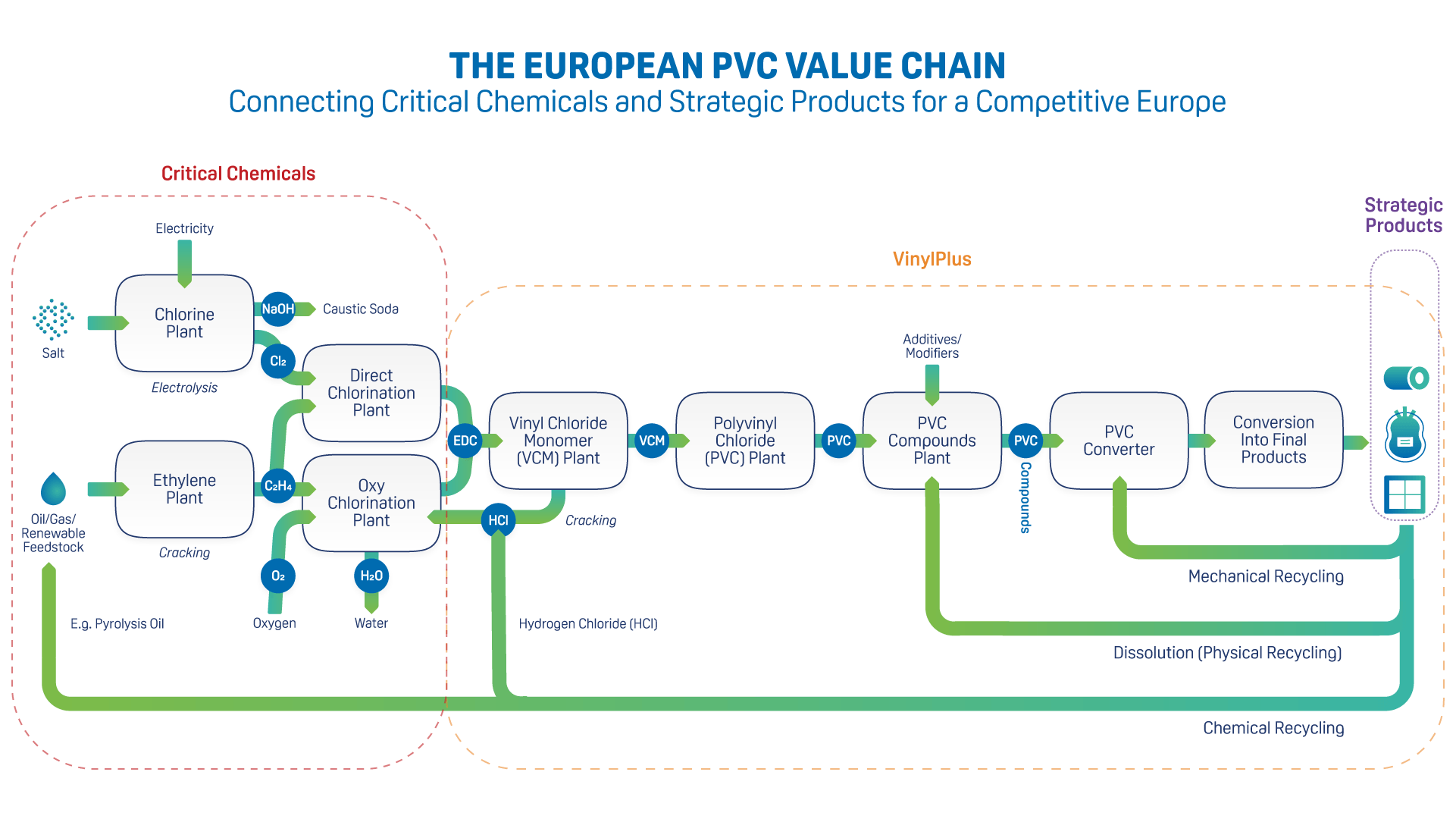
The European PVC value chain is also closely connected to Europe’s critical chemical industry. Because each molecule of PVC is composed of 57% chlorine, the European PVC production consumes roughly 30% of the annual production of chlorine, which is a by-product of the chlor-alkali industry. PVC therefore supports the economic efficiency and feasibility of one of the most critical chemical industries, directly supporting skilled jobs and strategic autonomy.
Today, this value chain is under increasing pressure from high energy and carbon costs, regulatory uncertainty, global oversupply, trade distortions and low-priced imports. These challenges risk weakening European production and reducing the capacity to invest in decarbonisation and innovation.
VinylPlus advocates for a policy framework that enables fair competition, regulatory clarity and investment in a circular and resilient European PVC industry.
Why Competitiveness Matters
01. A Strategic European Value Chain
PVC supports essential European sectors, including construction, infrastructure, healthcare, energy distribution, transport and manufacturing. Maintaining production, conversion and recycling capacity in Europe helps strengthen resilient supply chains and reduce dependency on imports.
02. Circularity Depends on a Strong Industrial Base
Circularity cannot be separated from competitiveness. Investment in collection schemes, sorting infrastructure, traceability tools, recycling capacity and markets for recycled PVC all depend on a viable and competitive European value chain.
03. Investment Requires Regulatory Certainty
The PVC value chain is investing in circularity, lower-carbon production, safer additives, certification and advanced recycling technologies. These investments require predictable, coherent and science-based regulation.
Key Challenges for the European PVC Value Chain
High Energy and Carbon Costs
PVC production is closely linked to energy-intensive upstream chemical processes. Persistently high energy and carbon costs in Europe can weaken competitiveness compared with regions where production costs are lower and environmental standards may differ.
Access to reliable and competitively priced low-carbon energy is essential if European industry is to maintain production, reduce emissions and invest in modernisation.
Regulatory Uncertainty
PVC products and additives are already extensively regulated in Europe. While regulation is necessary to protect people and the environment, poorly aligned rules can create unintended barriers to circularity and innovation.
For example, restrictions that do not adequately consider product-specific use, risk management, recycling loops or lifecycle performance may undermine circular economy objectives.
Global Oversupply and Low-Priced Imports
European producers and converters face increasing pressure from global oversupply and low-priced imports. Where imported products do not face equivalent environmental, social, reporting or regulatory requirements, European companies may be placed at a disadvantage.
VinylPlus supports free but also fair trade, ensuring a level playing field for both products made in and imported into Europe.
Pressure on Upstream Chemical Production
The PVC value chain is connected to the chlor-alkali industry, which is one of the most critical chemical industries for EU’s strategic autonomy. Following a domino effect, capacity reductions or plant closures in upstream production affects the availability of key raw materials and weaken Europe’s industrial resilience.
This is why VinylPlus supports EU initiatives that identify and safeguard critical chemical molecules, sites and value chains.
VinylPlus Policy Priorities
01. Strengthen European Production
Maintain and modernise PVC production, conversion and recycling capacity in Europe.
02. Support Fair Competition
Address unfair competition, trade distortions and low-priced imports where they undermine the competitiveness of the European industry.
03. Ensure Affordable Low-Carbon Energy
Enable access to reliable and competitively priced low-carbon energy for energy-intensive value chains.
04. Reduce Unnecessary Regulatory Burdens
Support coherent, science-based and risk-informed regulation that avoids unintended barriers to circularity.
05. Enable Circular Investment
Support investment in recycling, traceability, certification, lower-carbon production and advanced technologies.
06. Promote a Level Playing Field
Ensure proper enforcement of equivalent requirements for products made in and imported into Europe.
Relevant EU Policy Files
VinylPlus monitors and contributes to EU policy files relevant for industrial competitiveness, including:
- Clean Industrial Deal
- Industrial Accelerator Act
- Union Customs Code (Rules of origin)
- Public Procurement
- Critical chemicals
- Energy and carbon costs
- Trade defence
- State aid and investment support
VinylPlus in European Policy Alliances
The Critical Chemicals Alliance
VinylPlus participates in the European Commission’s Critical Chemicals Alliance, contributing to discussions on trade, modernisation and investment, and critical molecules and sites. This work is relevant to the resilience of Europe’s chemical and PVC value chains.
The Circular Plastics Alliance
VinylPlus is also part of the Circular Plastics Alliance, which is being relaunched and strengthened to address key challenges facing Europe’s plastics recycling sector. The alliance focuses on issues such as market surveillance, recycled plastics markets and customs codes for recycled polymers.
Connected to the VinylPlus 2030 Commitment
Competitiveness is not separate from sustainability. Delivering circularity, carbon reduction, transparency and innovation depends on a strong European PVC value chain that can continue to invest.
Through the VinylPlus 2030 Commitment, the European PVC value chain works to advance circularity, improve environmental performance, strengthen transparency and support responsible production and use.
A competitive European industry is essential to maintain this progress in Europe, from production and conversion to collection, recycling and verified use of recycled PVC.
Explore Related Policy and Action Areas
Competitiveness is closely linked to circularity, chemicals regulation, climate policy, construction, procurement and verified sustainability performance. Explore how VinylPlus connects policy engagement with practical action across the PVC value chain.
EU Policy Landscape
Explore the main EU policy files affecting the European PVC value chain.
Construction and Affordable Housing
See how durable PVC products contribute to affordable, energy-efficient and circular buildings.
Circular Economy and Waste
Explore the main EU policy files affecting the European PVC value chain.
Chemicals Regulation and Safe Materials
Learn why science-based, risk-informed regulation is essential for safe materials and circularity.
Certification and Traceability
Explore how verified sustainability certification schemes support transparency, responsible sourcing and circular PVC products.
Position Papers & Consultations
Read VinylPlus input on EU policy files affecting the PVC value chain.