Chemicals and Additives
VinylPlus supports a robust, science-based European chemicals framework that protects people and the environment while enabling circularity, innovation and the continued use of PVC in societally important applications.
Additives give PVC products the performance required for specific uses, including durability, flexibility, stability, colour and fire performance. Regulation should therefore be designed based on the function and behaviour of substances in their real product context, including how they are used, managed, controlled and recycled.
Chemicals legislation should be coherent and aligned with the broader EU policy framework, including competitiveness and circularity goals. Chemicals, product and waste rules should work together so that EU industry remains competitive and sustainable, the safest materials can remain in use, legacy substances are managed responsibly, and recycling is not unintentionally blocked.
VinylPlus supports a science-based, risk-informed and substance-specific approach to chemicals and additives policy.
Why Chemicals Policy Matters
01. Safety and Performance Go Together
Additives give PVC products the properties required for specific uses, including flexibility, durability, stability, colour and fire performance. The versatility of PVC products results from a carefully calibrated mix of physico-chemical properties between the polymer and its additives.
02. Regulation Must Reflect Real Use
Risk assessments of substances should take account of context, including the specific application and related exposure and risk management measures along the product’s, service life up to its end-of-life handling. Effective regulation is built in full consideration of how substances and productst are used, managed and controlled along the PVC product life-cycle, taking account of the specific applications.
03. Innovation Requires Predictability
Companies need clear and predictable rules to invest in safer additives, detection technologies, substitution, recycling and product-level sustainability. European Strategies and Roadmaps need to be updated regularly to reflect and align with evolving evidence, to truly guide Industry towards competitive sustainability.
VinylPlus Policy Priorities
01. Support Risk-Informed Regulation
Assess substances based on both hazard and exposure, to define truly risk-based measures taking account of the overall product use and life-cycle context.
02. Avoid Unjustified Blanket Restrictions
Ensure that measures aimed to address residual risks of PVC and PVC additives are addressed with the relevant specificity and nuance, addressing individual product- and substance-specific not treated as one undifferentiated category where substance-specific assessment is more appropriate.
03. Manage Legacy Additives Responsibly
Support controlled recycling loops, detection technologies and clear rules for legacy substances in recycled PVC.
04. Align Regulation to Enable Safe Recycling
Ensure chemicals, waste and product legislation work together so that compliant recycled PVC can be used safely in new products.
05. Support Sustainable Additives
Promote lifecycle-based tools such as the Additive Sustainability Footprint® to assess additives and their role in product performance.
06. Strengthen Evidence and Transparency
Support exposure monitoring and biomonitoring to inform robust risk-based regulatory decisions.
Relevant EU Policy Areas
VinylPlus monitors and contributes to EU policy developments affecting PVC, additives and recycled materials, including:
- REACH Restrictions including lead in PVC and the Restriction Roadmap
- Occupational exposure limits (OELs)
- Microplastics releases and exposure research
- Substances of concern in packaging and products
- Product legislation, recycled content and traceability
Additives and Product Sustainability
Additives are essential to PVC’s versatility and sustainability performance. They enable PVC to be formulated for rigid, flexible, transparent, durable, fire-performing and technically demanding applications.
Whether they represent only a small part or a larger part of a PVC product by weight, they make a significant contribution to how the product performs over its lifetime. They can support longer service life, reduced maintenance, improved functionality, safer use and better recyclability.
This is why additives should be assessed in relation to the full product lifecycle, from responsible sourcing and production to use, performance, exposure, maintenance, recycling and end-of-life management.
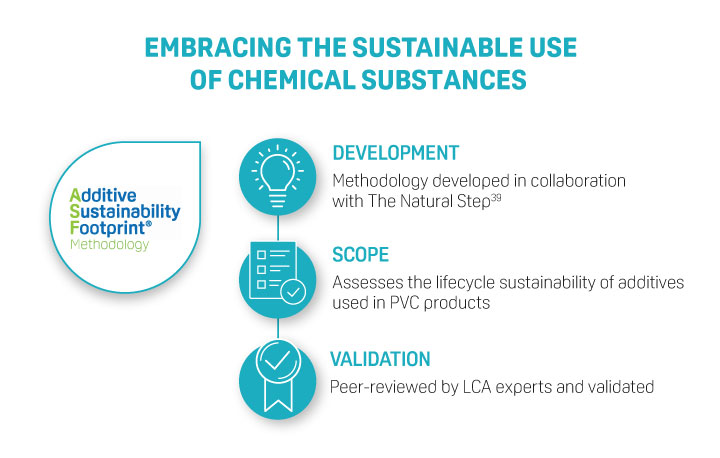
An example of an assessment methodology is the Additive Sustainability Footprint® (ASF). This VinylPlus methodology helps assessing and informing the sustainable production and use of PVC additives across entire product lifecycles, supporting performance and sustainability.
VinylPlus supports a substance-specific and risk-informed approach that recognises both safety requirements and the contribution additives can make to more sustainable PVC products.
Legacy Additives and Responsible Recycling
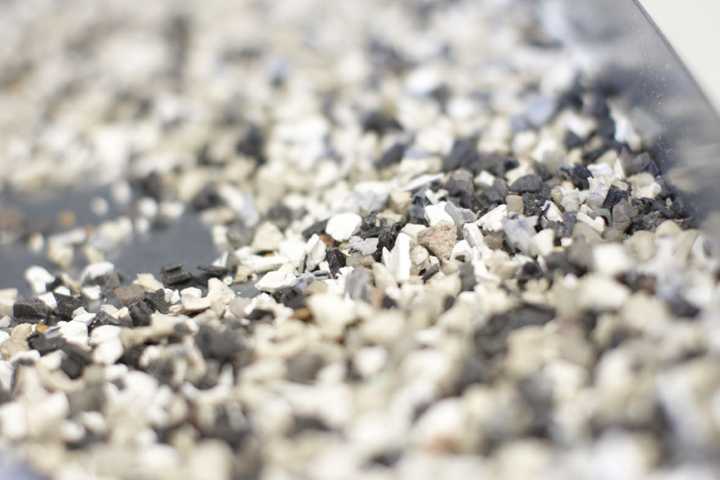
Many PVC products remain in use for decades. When these products eventually become waste, they may contain additives that are no longer used in new PVC products or are now subject to different regulatory requirements.
These legacy additives must be managed responsibly. This requires detection, sorting, traceability and clear rules for recycled PVC, including controlled applications where recycled material can be used safely.
Poorly aligned rules can unintentionally reduce recycling, even where risks are controlled. VinylPlus supports regulation that enables safe material recovery while maintaining high standards for health and environmental protection.
Evidence-Based Policy Engagement
VinylPlus supports scientific studies, technical assessments and stakeholder dialogue to inform chemicals regulation.
This includes work on risk management options for PVC additives, microplastics, legacy additives (e.g., lead in recycled PVC), as well as detection and sorting technologies. The aim is to provide robust evidence to identify the most proportionate regulatory approach and avoid decisions based on outdated information or general assumptions.
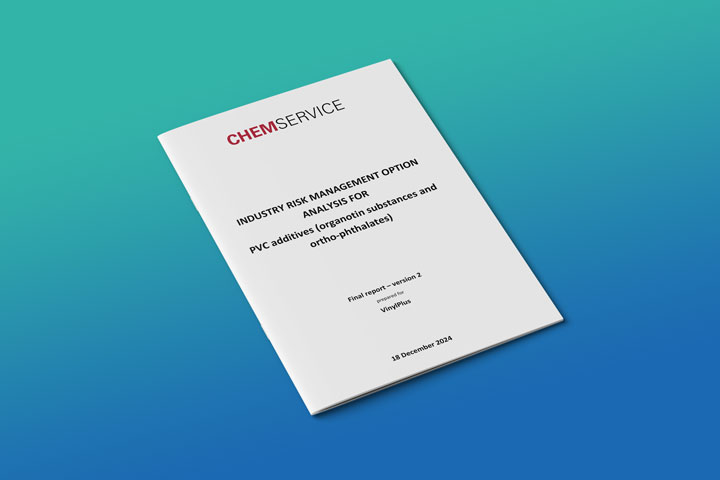
As part of this work, VinylPlus commissioned an industry Risk Management Option Analysis (i-RMOA) for organotin stabilisers and high molecular weight ortho-phthalate plasticisers (low molecular weight ortho-phthalates having been phased out in Europe).
The study assessed available scientific and regulatory evidence, exposure and risk management information, and the potential impacts of different regulatory options. It supports VinylPlus’ position that chemicals regulation should be substance-specific, risk-informed and based on real use conditions.
Risk Management
Supporting analysis of regulatory options for PVC additives and related substances.
Exposure and Monitoring
Promote lifecycle-based tools such as the Additive Sustainability Footprint® to assess additives and their role in product performance.
Detection Technologies
Supporting technologies that help identify legacy additives in PVC waste streams and enable sorting based on composition and responsible recycling.
Advanced Recycling
Supporting complementary recycling technologies that can treat complex PVC waste streams (for example, those containing legacy additives above permitted thresholds), where mechanical recycling is not suitable.
Connected to the VinylPlus 2030 Commitment
Chemicals and additives policy is closely linked to the VinylPlus 2030 Commitment. Safe and sustainable additives, responsible recycling, traceability and science-based regulation all support a more sustainable PVC value chain.
VinylPlus works across the value chain to provide evidence, develop tools and support innovation that enables safe PVC products and responsible use of recycled PVC.
The Additive Sustainability Footprint is one example of this work. It helps assess and promote the sustainable production and use of PVC additives across the product life cycle, including the role additives play in product performance.
Explore Related Policy and Action Areas
Competitiveness is closely linked to circularity, chemicals regulation, climate policy, construction, procurement and verified sustainability performance. Explore how VinylPlus connects policy engagement with practical action across the PVC value chain.
Additive Sustainability
Learn how VinylPlus supports the safe and sustainable use of additives through tools such as the Additive Sustainability Footprint.
Detection and Sorting Technologies
Learn how innovation supports better sorting and safe recycling of PVC waste streams.
Circular Economy and Waste Policy
See how chemicals, waste and product rules must work together to enable safe recycling.
Certifications and Traceability
Explore how verified schemes support transparency, responsible sourcing and circular PVC products.
EU Policy Landscape
Explore the main EU policy files affecting PVC, additives, products and circularity.
Position Papers and Consultations
Read VinylPlus policy input and consultation responses.