Additive Sustainability
Additives are essential to PVC’s versatility. They help deliver the properties required in specific applications, including flexibility, durability, fire performance, weather resistance, transparency, colour, processing efficiency and long service life.
The sustainability of PVC (vinyl) products therefore depends not only on the polymer itself, but also on the responsible selection and use of additives across the full product life cycle.
VinylPlus supports a science-based approach to additive sustainability. This includes regulatory compliance, risk assessment, lifecycle thinking, product performance, circularity and continuous improvement across the vinyl value chain.


Why Additive Sustainability Matters
PVC is used in a wide range of applications, from pipes, windows, cables and flooring to medical devices, packaging and coated fabrics. Each application has specific technical requirements, and additives make it possible to tailor vinyl to meet these needs.
A sustainable approach to additives must therefore consider both the safety and environmental profile of the additive and the function it provides in the final PVC product.
Additives can contribute to longer service life, lower maintenance, improved fire performance, recyclability, processing efficiency and safe use in demanding applications. Assessing additive sustainability means looking at this broader context.
This is why VinylPlus works with a lifecycle-based approach: additives are not assessed only as isolated substances, but as functional components in PVC products that deliver specific performance over time.
Additive Sustainability Footprint Methodology
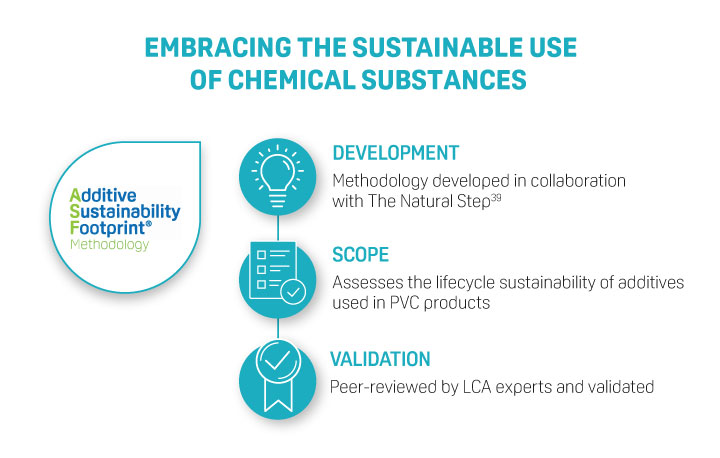
The Additive Sustainability Footprint® , or ASF, is a VinylPlus methodology developed to assess and support progress towards the sustainable use of additives in PVC products.
ASF was developed with The Natural Step and applies strategic life-cycle thinking to the use of additives in finished PVC articles. It takes a risk-based approach and considers additives in the context of the product in which they are used, including their function, performance and contribution across the product life cycle.
The methodology helps companies identify sustainability strengths, knowledge gaps and improvement opportunities. It is designed as a continuous improvement tool, supporting innovation and value-chain dialogue rather than acting as a simple pass/fail assessment.
Run an ASF Assessment
Any VinylPlus partner can apply to run an ASF assessment for its own specific products. The process supports in-house learning, improvement planning and dialogue across the value chain.
What ASF Assesses
ASF combines life-cycle stages with sustainability principles to assess additive use in context. It considers raw materials, additive production, packaging and distribution, PVC compounding and converting, product use, and product fate.
The methodology can help assess:
- NResponsible sourcing of raw materials
- NEnvironmental and social impacts across the life cycle
- NProduct performance and durability
- NRecyclability and end-of-life options
- NKnowledge gaps in supply chains
- NOpportunities for substitution or reformulation
- NImprovement priorities for additive producers, compounders and converters
From Assessment to Improvement
ASF supports practical improvement by helping companies identify life-cycle “hotspots” and areas where further information, innovation or action may be needed.
The process can support internal learning, supplier dialogue, product development and sustainability planning. It also provides a structured way to consider how additives contribute to product performance, safe use, circularity and long-term sustainability.
ASF is best understood as a tool for progress: it helps companies understand where they are today and how they can move towards more sustainable additive use over time.
“The PVC industry has […] taken an active role by phasing out those substances even before the regulatory measures were implemented.”
European Chemicals Agency. (2023). Investigation Report on PVC and PVC Additives, https://echa.europa.eu/documents/10162/17233/rest_pvc_investigation_report_en.pdf
Evidence-Based Action on PVC Additives
VinylPlus supports science-based and regulatory discussions on PVC additives with technical data, lifecycle context and coordinated input from across the European PVC value chain.
This work complements the Additive Sustainability Footprint by ensuring that additive assessment is grounded in evidence, actual use conditions, exposure, product performance and risk management.
Substituting Unwanted Additives Ahead of Regulation
Through VinylPlus, the European PVC industry supported the substitution of lead stabilisers and certain phthalates before EU restrictions came into force. This proactive approach helped the value chain prepare for regulatory change, develop safer alternatives and safeguard market access.
Early coordination through VinylPlus enabled companies to align on common objectives within competition law boundaries, while partners across the value chain developed and implemented alternative additive systems.
Coordinated Response to ECHA’s PVC Investigation
In response to the European Chemicals Agency’s (ECHA) investigation into PVC and PVC additives, VinylPlus coordinated an industry-wide contribution, bringing together technical and regulatory input from across the value chain.
The contribution addressed additive use, alternatives, exposure, migration, recycling and risk management, helping provide a consistent evidence base for discussions on PVC and its additives.
This work strengthened VinylPlus’ role as a credible interlocutor with EU institutions and helped the industry speak with one voice on complex technical and regulatory questions.
Additive Sustainability and Circularity
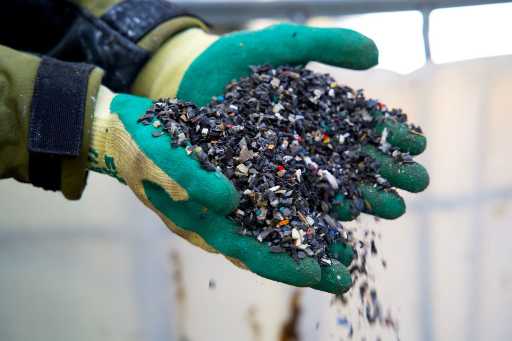
Additive sustainability is closely linked to circularity. Many PVC products have long service lives. This means that older products entering the waste stream may contain legacy additives that are no longer used in new PVC products. A responsible circular economy must therefore combine recycling with sorting, detection, risk management and regulatory compliance.
ASF helps companies consider how additives affect recyclability and the safe use of recycled PVC. It supports the principle that additives should not restrict efficient resource management, recyclate quality or future recycling options.
This connects additive sustainability directly to VinylPlus’ work on circularity, sorting and detection, advanced recycling and safe use of recyclates.
A Tool for Continuous Improvement
Additive sustainability is not a one-time assessment. It is a continuous process of improving knowledge, reducing risks, strengthening performance and supporting circularity.
Through the Additive Sustainability Footprint, VinylPlus provides a structured methodology for companies to assess additive use, identify improvement opportunities and support more sustainable PVC products across their full life cycle.
Together with responsible production standards, certification, circularity projects and science-based regulatory engagement, ASF helps strengthen the sustainability performance of the European PVC value chain.