Advanced Recycling
Mechanical recycling remains the preferred and most widely used route for suitable PVC waste streams. It keeps the polymer intact, preserves material value and already supports recycling at scale across several PVC applications. Depending on application, both rigid and flexible PVC products can be recycled mechanically several times without significant loss of functional properties.
Some PVC waste streams, however, are more complex. They may contain legacy additives, be part of composite products, or be difficult to separate using conventional recycling routes. For these streams, advanced recycling technologies can complement mechanical recycling and help recover material or chemical value that would otherwise be lost.
Advanced recycling is therefore not a replacement for mechanical recycling. It is an additional set of technologies designed to expand circularity for waste streams that are difficult to recycle through established routes.
Mechanical Recycling Remains the Preferred Route
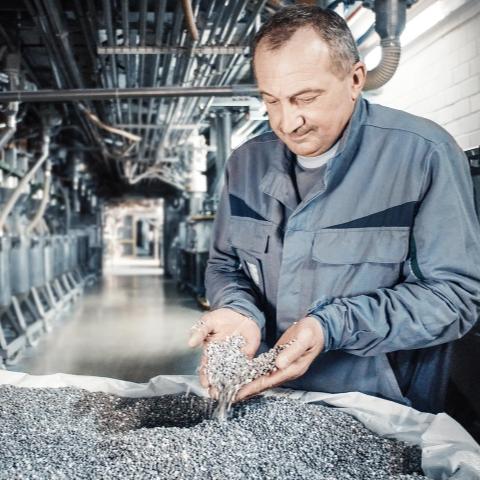
Mechanical recycling is the established route for suitable PVC waste streams. It involves collecting, sorting and reprocessing PVC waste without changing the polymer’s chemical structure.
This route is particularly effective for clean and relatively homogeneous waste streams, such as window profiles, flooring, cables, pipes and other durable PVC applications. It enables recycled PVC to be used in new products while retaining key technical properties.
Mechanical recycling generally has the lowest environmental impact compared to physical recycling, chemical recycling, and energy recovery. It is therefore considered the preferred choice for managing plastics waste, according to the European Commission’s Joint Research Centre (JRC).
Advanced recycling builds on this foundation by addressing PVC waste streams that are too complex, mixed or difficult to recycle mechanically.
Complementary Recycling Technologies
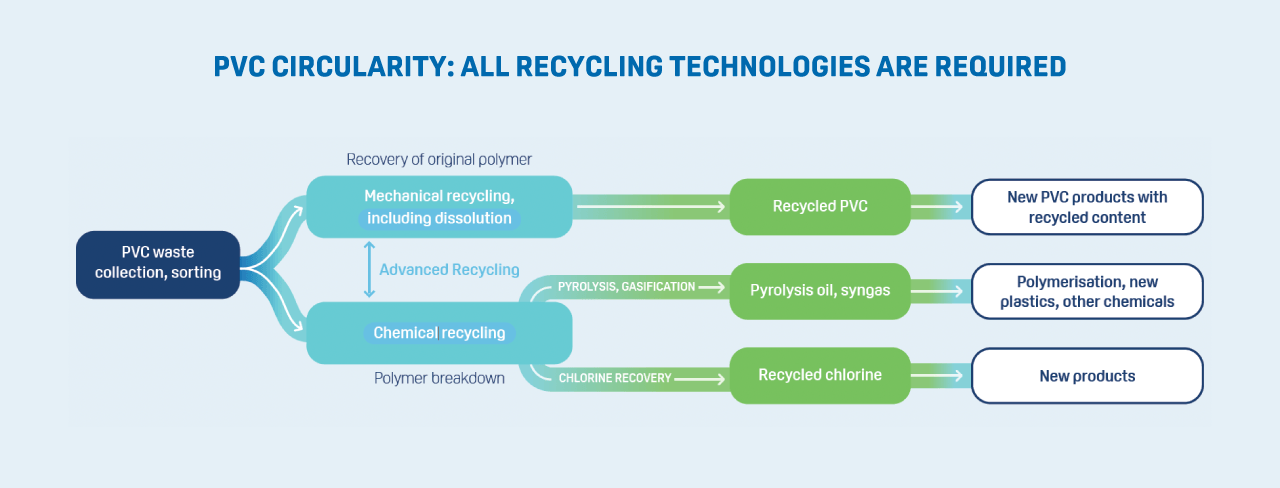
Different PVC waste streams require different recycling routes. Mechanical recycling, including dissolution, recovers the original polymer, while chemical recycling breaks the polymer down into useful chemical outputs. Sorting and detection are essential to identify waste streams and direct them to the most appropriate route.

Physical Recycling, Dissolution and Purification
Physical recycling technologies recover the PVC polymer without breaking it down into chemical building blocks. This includes dissolution, selective separation, extractive extrusion and purification processes that can help recover PVC from complex waste streams.
These technologies are particularly relevant where PVC is combined with other materials, where high-purity recyclate is required, or where legacy additives must be removed or managed to produce recycled PVC that meets regulatory requirements. Relevant waste streams include pharmaceutical blister packaging, coated fabrics, tarpaulins, flooring, multi-layer products, composite products and PVC waste containing legacy additives.
Because the PVC polymer is preserved, physical recycling can support high-quality recycling while enabling the separation of materials such as aluminium, textiles and coatings. It can also help remove legacy plasticisers and extract heavy metals into separate streams, supporting the production of recycled PVC suitable for use in new products.
VinylPlus Involvement
The following examples include projects directly supported by VinylPlus as well as initiatives involving VinylPlus members, partners and founding members. Together, they show how the wider VinylPlus network is developing physical recycling, purification and additive-removal technologies for complex PVC waste streams.
RETAIN
VinylPlus is a partner in RETAIN, a Horizon Europe project focused on building a circular value chain for PVC tarpaulins. The project addresses repair, reuse, remanufacturing and recycling, including advanced mechanical, physical and selective dissolution recycling technologies.
VinylPlus contributes to communications, stakeholder engagement, logistics, gate control systems, recycling process optimisation and market development for recyclates.
VinylPlus® PharmPack
Developing recycling routes for rigid PVC pharmaceutical blister films. A peer-reviewed scientific article confirms the feasibility of dissolution-based recycling for aluminium/PVC blister waste. Pilot-scale CreaSolv® trials have recovered high-purity recycled PVC, enabling demonstration-scale production of pharma-grade blisters containing 30% recycled PVC.
EUPolySep
Led by VinylPlus founding member EuPC, EUPolySep applies delamination and separation technologies to extract PVC from multi-layer and composite products, supporting higher-quality recycling routes for complex waste streams.
REMADYL
A completed Horizon 2020 project in which VinylPlus participated, focused on removing legacy phthalates and heavy metals from end-of-life PVC. The project combined extractive extrusion, solvent-based purification and melt filtration to support the production of high-purity, REACH-compliant recycled PVC.
INEOS Inovyn – Project Circle
Advancing dissolution and purification technologies to remove contaminants and legacy additives from flexible and rigid PVC waste, with pilot plants in Belgium and industrial-scale implementation targeted by 2030.
Kem One / REHAU
Developing selective dissolution for post-consumer rigid PVC waste, using bio-sourced solvents to remove heavy metals from pipes, fittings and profiles.
Vynova
Researching dissolution and membrane filtration technologies to remove heavy metals from rigid post-consumer PVC waste, including profiles and pipes.
Serge Ferrari / Polyloop
Developing selective dissolution and precipitation for flexible composite PVC materials, including coated fabrics and other multi-layer applications.
Baerlocher
Developing additive-removal procedures for post-consumer PVC waste, including the extraction of legacy heavy metals such as lead and cadmium. This can support the production of higher-quality recycled PVC and help enable the safe use of recyclate in new products.
DISSOLV
A consortium involving VinylPlus partners Beaulieu International Group, Sioen Industries, ExxonMobil, and INEOS Inovyn that is developing advanced dissolution technology to separate PVC from other materials, remove legacy additives and recover valuable components such as plasticisers and polyester fibres.
CIRC-PVC
A Belgian consortium involving INEOS Inovyn, addressing the PVC recycling chain from construction and demolition waste collection to rejuvenated PVC free from legacy additives.
Circular Flooring
A completed Horizon 2020 project developing a circular recycling process for post-consumer PVC flooring, including the safe treatment of legacy plasticisers and the production of high-quality recyclates.
How VinylPlus Drives Advanced Recycling for PVC
Eric Romers, Leader of the VinylPlus Advanced Recycling Task Force and Head of Project Circle at INEOS Inovyn, explains how VinylPlus is advancing complementary recycling technologies for PVC waste streams that are difficult to recycle mechanically.
Chemical Recycling of PVC
Chemical recycling can be relevant for PVC waste that cannot be mechanically or physically recycled. These technologies recover chemical value from complex waste streams and can produce outputs for use in new materials or other chemical processes.
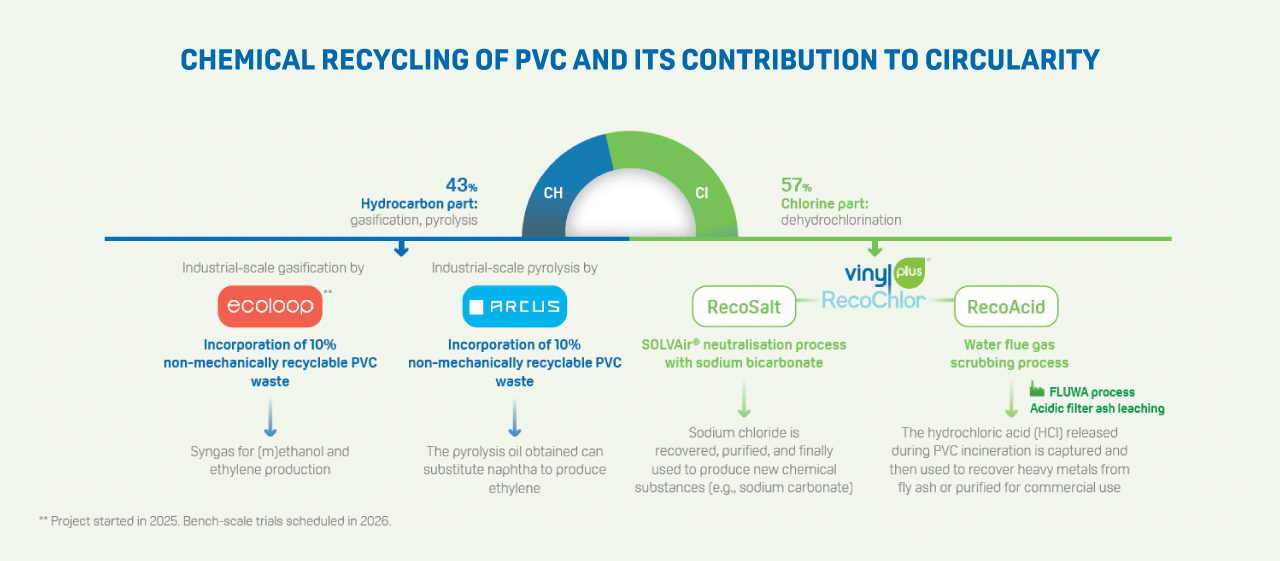
For PVC, chemical recycling is particularly relevant because the material contains both a hydrocarbon part and a chlorine part. Circularity can therefore involve both recovery of carbon-based feedstock and recovery of chlorine.
Compatibility With Mixed Plastic Streams
PVC can be compatible with chemical recycling of mixed plastic streams when the process is designed to manage chlorine effectively. Because PVC contains chlorine, feedstock composition, dechlorination, hydrogen chloride management, neutralisation and downstream purification must be considered from the outset.
Several complementary approaches are being developed. In some cases, PVC can be separated from hydrocarbon polymers before recycling, allowing different fractions to be treated through the most appropriate route. In other cases, controlled pyrolysis or gasification processes are being tested to demonstrate how PVC-containing feedstocks can be processed under managed conditions.
This is important because PVC should not be seen as a barrier to the recycling of other plastics. With the right technology and process controls, PVC-containing streams can be directed to suitable routes where both the hydrocarbon and chlorine fractions can be recovered or managed safely.
Examples of Technology Development
- ARCUS Greencycling Technlogies – has demonstrated the successful processing of mixed plastic feedstock containing up to 10% PVC under controlled pyrolysis conditions, including effective hydrogen chloride management.
- SynPet Technologies – identifies PVC among accepted feedstock streams in its technology documentation.
- Lummus Technology (New Hope Technologies) – technical materials indicate the capability to manage limited PVC content (2%) in polyolefin-based feedstock.
- Pryme Cleantech – references PVC within mixed plastic feedstock and addresses halogen management in process descriptions.
- SABIC (patent WO 2025238544 A1) – describes treatment of pyrolysis oil under autogenic pressure using basic adsorbents to hydrolyse organic chlorides and capture hydrogen chloride, directly addressing chloride clean-up from PVC-containing feedstock.
- Chevron (patent US 20250340786 A1) – outlines a process for mixed plastic feed (including PE, PP and PVC) incorporating dechlorination and chloride guard-bed systems to reduce chlorine levels to refinery-compatible specifications.
- Resonac Corp (patent WO 2025191752 A1) – discloses a pyrolysis device for halogen-containing plastics using salt-forming agents to bind hydrogen chloride as non-volatile salts, improving downstream product quality.
Pyrolysis
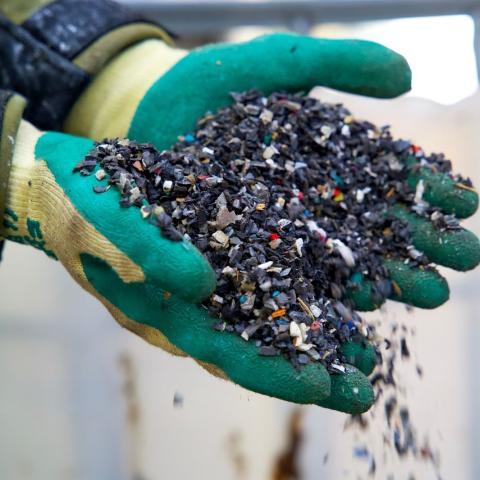
Pyrolysis is a thermochemical process that breaks down organic materials using heat in an oxygen-free environment. In plastics recycling, it can transform difficult-to-recycle waste into oils and chemical components that may be used as feedstock for new materials or in specific industrial processes.
For PVC-containing waste streams, pyrolysis is relevant where the material cannot be mechanically recycled. Chlorine management is a key part of the process, as PVC contains chlorine that must be safely separated or recovered.
VinylPlus Involvement
VinylPlus supports the development and testing of pyrolysis routes for PVC waste streams that cannot be recycled mechanically. This work focuses on demonstrating whether PVC-containing waste can be safely processed, how chlorine can be managed, and whether the resulting outputs can meet the quality requirements of petrochemical value chains.
Alongside direct project work, VinylPlus members and partners are also exploring pyrolysis and related thermo-chemical technologies as part of broader circularity and decarbonisation initiatives.
Arcus
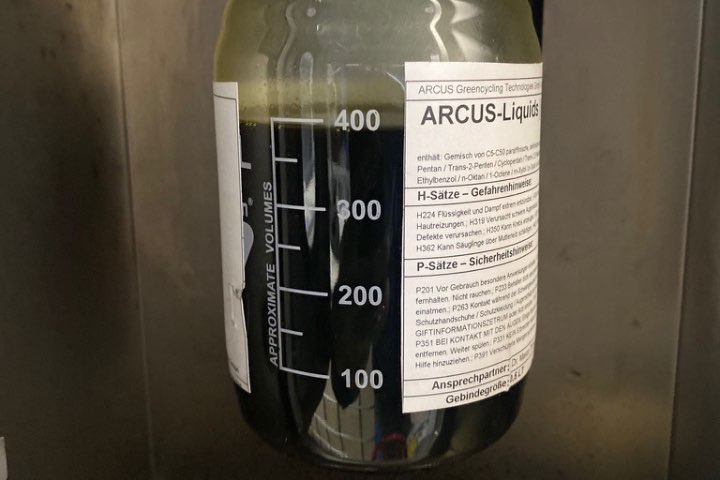
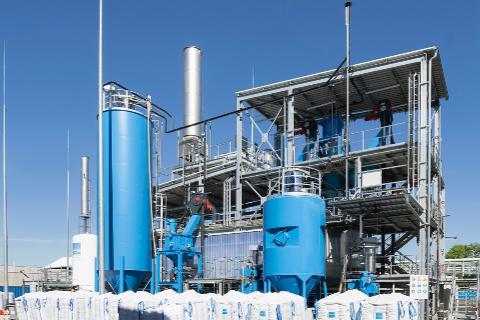
Arcus Greencycling Technologies and VinylPlus have demonstrated at industrial scale that PVC can be processed as part of a pyrolysis feedstock using ARCUS’ technology. Trials with mixed polyolefin feedstock containing flexible PVC produced pyrolysis oil with virtually unchanged properties compared with oil from 100% mixed polyolefin feedstock.
Bench-scale trials have also shown that lead-containing cable sheathing waste can be included in the pyrolysis feedstock without affecting the quality of the oil produced. Independent assessment has confirmed that the resulting pyrolysis oil can be processed in a steam cracker, either with dilution or after standard hydrotreatment.
INEOS Inovyn – Project Circle
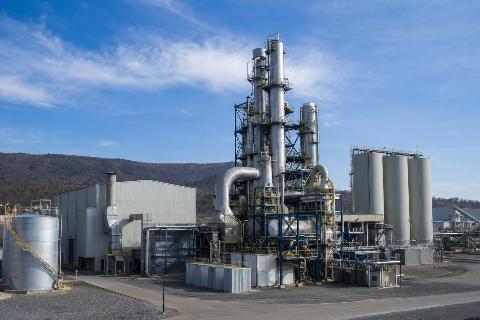
Project Circle by VinylPlus partner INEOS Inovyn includes pyrolysis development focused on HCl extraction and carbon recovery from PVC-containing waste streams, alongside dissolution and gasification routes for more complex fractions.
H2 Reallabor – ChemDelta Bavaria
A project involving VinylPlus partner Westlake Vinnolit, exploring thermo-chemical conversion of complex residual materials, including mixed plastics and chlorine-containing waste, through pyrolysis and plasma gasification. The work aims to produce hydrogen-rich synthesis gas, pure hydrogen and solid carbon.dissolution for post-consumer rigid PVC waste, using bio-sourced solvents to remove heavy metals from pipes, fittings and profiles.
Gasification
Gasification is a high-temperature process that converts complex plastic waste streams into syngas. This syngas can be used as a feedstock for new chemicals or materials.
For PVC-containing waste, gasification can be relevant where waste streams are mixed, contaminated or otherwise difficult to recycle mechanically. It can also support chlorine recovery in the form of useful chemical feedstocks.
VinylPlus Involvement
ecoloop
VinylPlus is working with ecoloop in exploring gasification as a complementary route for non-mechanically recyclable PVC waste. The focus includes feedstock selection, ash behaviour, chlorine release, neutralisation strategies and syngas quality. The aim is to incorporate 10% PVC to produce (m)ethanol and ethylene at industrial scale, with trials running in 2026.

Chlorine Recovery
PVC contains chlorine, derived from common salt. In difficult-to-recycle PVC waste, chlorine recovery technologies can help recover this part of the material for further use.
VinylPlus® RecoChlor is a programme aimed at recovering chlorine from difficult-to-recycle PVC waste treated in waste-to-energy plants. During flue gas treatment, the chlorine fraction can be recovered either as sodium chloride through RecoSalt or as diluted hydrochloric acid through RecoAcid, while the hydrocarbon fraction is recovered as energy.
RecoSalt
In the RecoSalt route, hydrochloric acid generated during thermal treatment is neutralised and the resulting sodium chloride is recovered, purified and made available for use in new chemical processes. The recovery of sodium chloride from flue-gas treatment residues is recognised as recycling operation in the Best Available Techniques Reference Document for Waste Treatment.
RecoAcid and VinylMet
In the RecoAcid route, hydrochloric acid from flue gas treatment can be used in the FLUWA process, a fly-ash washing and acidic leaching process used to recover metals from municipal waste incineration residues. In Switzerland, FLUWA is a compulsory process, making it an important reference case for chlorine recovery from PVC-containing waste.
The VinylMet project builds on this route by exploring how industrial PVC waste can help generate hydrochloric acid in situ and support heavy-metal recovery from fly ash. Trials using PVC cable-sheathing granulates confirmed increased acid production and higher heavy-metal concentrations in fly ash, without additional dioxin formation in cleaned exhaust gases.
Learn More
- Quina, M.J., et al. (2018). Technologies for the Management of MSW Incineration Ashes From Gas Cleaning: New Perspectives on Recovery of Secondary Raw Materials and Circular Economy. https://doi.org/10.1016/j.scitotenv.2018.04.150
- Zucha, W. et. al. (2020). Inventory of MSWI Fly Ash in Switzerland: Heavy Metal Recovery Potential and Their Properties for Acid Leaching. https://doi.org/10.3390/pr8121668
Sorting Directs Waste to the Right Route
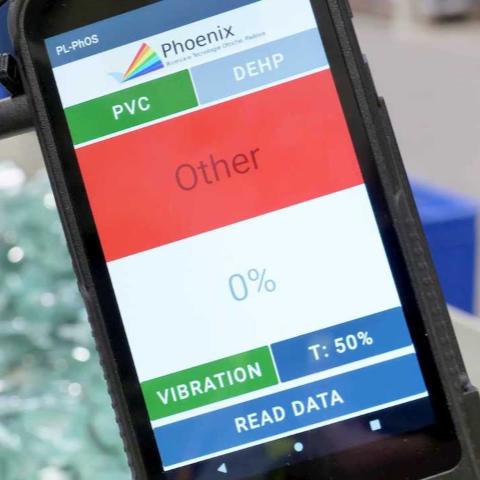
Advanced recycling depends on effective sorting and detection. Waste streams must be identified, characterised and directed to the most appropriate recycling route, whether mechanical, physical or chemical.
Detection technologies also help manage legacy additives in recycled PVC streams, supporting quality, compliance and confidence in recycled materials.
VinylPlus supports work on detection and sorting technologies that can help identify PVC waste streams and manage additives that may affect recycling. This includes work on technologies such as X-ray fluorescence and near-infrared detection to identify specific substances and separate materials more effectively.