
Design for Recycling
Design choices made today influence whether PVC products can be effectively collected, sorted and recycled at end of life. Design for recycling helps keep valuable PVC materials in circulation for longer by considering recyclability, material compatibility, additives, dismantling, identification and future recycling routes already at the product development stage.
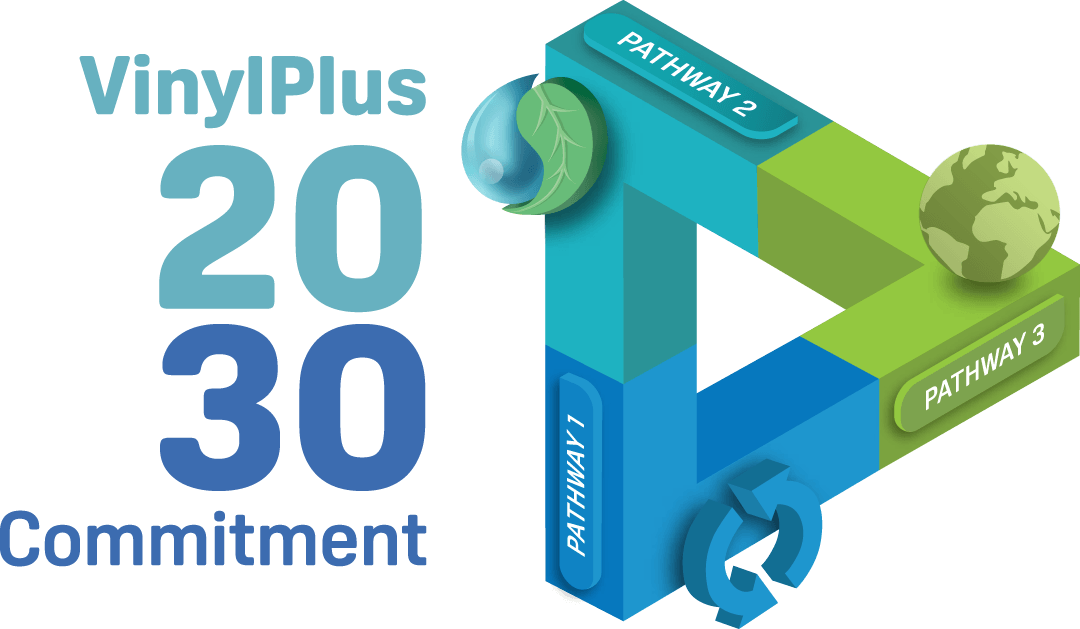
For VinylPlus, design for recycling supports Pathway 1 of the VinylPlus 2030 Commitment: Scaling Up PVC Value Chain Circularity. Under the revised Commitment, VinylPlus will report annually from 2026 on partners’ ecodesign progress per application sector.
Why Design for Recycling Matters
Polyvinyl chloride (PVC or vinyl) is used in applications with very different lifetimes — from long-life building products such as pipes, window profiles, flooring, cables, films and membranes to shorter-use applications such as packaging and medical products. Across these applications, better design can make it easier to identify, separate and recycle PVC at end of life.
Design for recycling is not only about the material itself. It also concerns how products are assembled, which additives and layers are used, whether components can be separated, and whether recyclers can recognise and process the waste stream efficiently.
By considering circularity at the design stage, PVC products can be better prepared for future collection, sorting, recycling and use of recycled PVC in new products.
Versatility That Supports Circular Design
PVC is the most versatile plastic and can be formulated as rigid or flexible material for a wide range of applications. In many cases, PVC products can be designed as mono-material or largely PVC-based systems, which can support more straightforward sorting and recycling.
By contrast, substituting PVC with alternative materials can lead to more complex product designs, including multilayer or multi-material structures needed to achieve similar performance. This makes separation and recycling more difficult.
What Design for Recycling Means
Design for recycling can be understood through four practical principles: material compatibility, identification and sorting, additive and recyclate safety, and long-term circularity.
01. Choose Compatible Materials
Material combinations should support future recycling where possible. Avoiding unnecessary complexity can make products easier to sort, separate and process.
02. Enable Identification and Sorting
Clear material identification, compatibility with detection technologies and access to reliable product information can help recyclers direct PVC waste to the right recycling route. Digital Product Passports can support this by making data on material composition, recycled content and end-of-life options available across the value chain.
03. Consider Additives and Recyclate Safety
Additives give PVC products their performance, but design choices should also support safe use, regulatory compliance and future recyclability.
04. Design for Long-Term Circularity
Products should be designed not only for performance during use, but also for collection, dismantling, recycling and use of recycled PVC in new products.
05. Design With Traceability in Mind
Digital Product Passports can help make information on material composition, recycled content and end-of-life options available to recyclers, converters and other value-chain actors. This supports better sorting, safer recycling and more transparent circularity.
Standardisation and Design Guidance
Design for recycling is increasingly being translated into European standards and technical guidance. The Ecodesign for Sustainable Products Regulation sets a broader framework for improving product sustainability, including durability, reparability and recyclability, while European standardisation work helps turn these requirements into practical specifications and test methods.
In line with the European Commission’s Standardisation Mandate M/584 on plastics recycling and recycled plastics, VinylPlus and its sector partners contribute to standardisation work for relevant PVC applications, including windows, flooring, pipes and cables.
Examples include design-for-recycling guidance for PVC-based profiles for construction products, circularity and sustainability guidance for flooring, and design-for-recycling guidelines for thermoplastic pipes and fittings. In 2025, the pipe guidelines developed with TEPPFA’s contribution were released and made available through national standardisation bodies in most European countries.
VinylPlus also supports work to ensure that sustainability requirements do not compromise product performance or safety. For example, VinylPlus Cables commissioned fire-scenario modelling to assess whether current standard fire-test methodologies adequately reflect real fire behaviour for PVC cables with additives.

Ecodesign Progress by Application Sector
Design for recycling is part of a broader ecodesign approach. From 2026, VinylPlus will report annually on partners’ ecodesign progress per application sector as part of the revised VinylPlus 2030 Commitment.
This sector-based approach recognises that PVC applications have different functions, lifetimes, regulatory requirements and recycling routes. Ecodesign for a pipe, a window profile, a cable, a flooring product, a membrane, a packaging application or a medical product will not always mean the same thing. What matters is that circularity is considered in a way that is relevant to the product, its use phase and its realistic end-of-life pathway.
Explore Related Topics
Design for recycling is one part of a wider circularity strategy, connected to collection, sorting, recycling technologies, additive sustainability and the use of recycled PVC in new products.