Environmental Footprint
VinylPlus works with the European PVC value chain to document and reduce the environmental footprint of PVC products, production processes and supply chains. This includes work on defossilisation, decarbonisation, renewable energy, sustainable feedstock, life-cycle assessment, environmental product data, responsible production and the safe use of additives.
This work supports Pathway 2 of the VinylPlus 2030 Commitment: Advancing Towards Carbon Neutrality and Minimising Our Environmental Footprint.


Why Environmental Footprint Matters
PVC is used in applications where durability, performance and resource efficiency matter — from pipes, windows and cables to flooring, membranes, healthcare products and packaging. Understanding environmental footprint means looking beyond one single indicator and assessing impacts across the life cycle: raw materials, production, transport, use, maintenance, recycling (including number of possible successive recycling cycles) and end of life.
For VinylPlus, this means supporting science-based data, life-cycle assessment, environmental product declarations, responsible production standards and circular solutions that can reduce the carbon and water footprints of PVC products.
How VinylPlus Supports Lower Environmental Footprint
01. Carbon Reduction
VinylPlus supports work to understand and reduce greenhouse gas emissions across the PVC value chain, including through carbon footprinting, electrification, low-carbon electricity, hydrogen and circular material use.
02. Environmental Data and LCA
Life-cycle assessment, eco-profiles and environmental product declarations help document the performance of PVC products and support more informed decision-making.
03. Responsible Production
The European PVC polymer industry works under the ECVM Industry Charter, which sets requirements to reduce environmental and human health impacts in the production of VCM and PVC.
04. Circular Materials
The use of recycled PVC reduces environmental impacts compared with virgin material, helping keep resources in use and reducing the need for new raw materials.
Progress in Practice
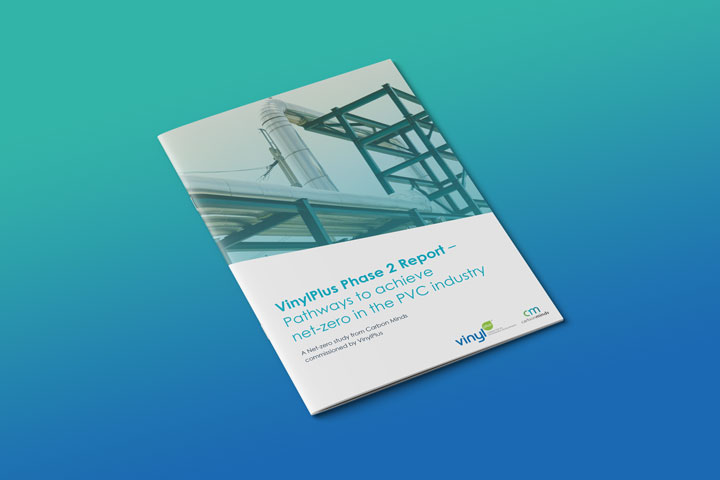
VinylPlus has worked with Carbon Minds to develop a science-based understanding of the environmental footprint of the European PVC value chain and the pathways towards carbon neutrality.
The work was carried out in two phases. Phase 1 established a life-cycle assessment baseline for six key PVC product groups in Europe: window frames, cables, pipes, films and sheets, membranes and flooring. The assessment focused on carbon footprint and water footprint, covering cradle-to-gate plus end-of-life.
Phase 2 built on this baseline by modelling cost-efficient pathways to reduce climate and water impacts across the PVC value chain. The study shows that there is no single route to net zero, but that different combinations of recycling, affordable renewable energy, sustainable biomass and carbon capture and storage can contribute to the transition.
Pathway 1
LCA baseline for six PVC product groups
Pathway 2
Net-zero pathways for the PVC value chain
Possible Next Steps
Policy translation, product-level tools, and developing a carbon handprint
Environmental Product Data
Reliable environmental data is essential for credible sustainability claims, public procurement, product policy and informed material choices. VinylPlus supports the use of life-cycle assessment, product carbon footprint work, eco-profiles, environmental product declarations and independently verified datasets to document the environmental performance of PVC products and materials.
This includes European-average environmental impact data for PVC polymer and precursors, life-cycle assessment work for PVC product applications, and new datasets for recycled PVC. The Plastics Europe Eco-Profile Programme provides cradle-to-gate environmental impact data for plastic polymers and their precursors, developed and independently verified by LCA experts. The latest VCM and PVC eco-profile was published in 2023 and included in ecoinvent 3.11 in 2024.
TEPPFA also commissioned two Life Cycle Inventory datasets for recycled PVC products — micronised powder and flakes — using EU average data. These datasets were released in 2025 after external peer review and are compliant with ILCD Entry Level Requirements and ISO 14040/14044 LCA standards.
Eco-Profiles
European-average environmental impact data for VCM and PVC, supporting transparent cradle-to-gate assessment.
Recycled PVC Datasets
LCI datasets for recycled PVC powder and flakes help document the environmental footprint of recyclates and support their use in new products.
Environmental Product Declarations
EPDs and verified datasets provide structured environmental information that can support procurement, product policy and market communication.
LCA and Product Carbon Footprints
Life-cycle assessment and product carbon footprint work help identify environmental hotspots and support better decision-making across the PVC value chain.
Responsible Production and Additives
Environmental footprint is not only about carbon. It also includes emissions, responsible chemical use, additive sustainability, production standards and the prevention of polymer and compound spillages.
VinylPlus supports continuous improvement across the PVC value chain through voluntary standards, certification tools and science-based assessment methods, including the ECVM Industry Charter and the Additive Sustainability Footprint®.
ECVM Industry Charter
The ECVM Industry Charter is a voluntary production standard for VCM and PVC resin manufacturing in Europe, supporting continuous improvement in environmental performance, occupational health and safety, emissions control and responsible production practices.
Additive Sustainability Footprint®
The Additive Sustainability Footprint® is a methodology for assessing the sustainability performance of additives used in PVC products, considering their role in product performance, durability, safe use, circularity and life-cycle impacts.