
Decarbonisation Pathways
Innovation can help reduce the climate impact of PVC (vinyl) production and applications. This includes energy efficiency, lower-carbon feedstocks, renewable energy use, circular material flows and product solutions that support long service life and resource efficiency.
Through the VinylPlus 2030 Commitment, the European PVC value chain is working to better understand, reduce and document its carbon and environmental footprint. This work is closely connected to Pathway 2: Advancing Towards Carbon Neutrality and Minimising Our Environmental Footprint.

Why Decarbonisation Matters
PVC is used in essential applications across construction, water management, energy infrastructure, healthcare, mobility and everyday life. These products can support durability, resource efficiency and infrastructure resilience, but the PVC value chain must also reduce its own climate impact.
Decarbonising PVC requires a value-chain approach. Carbon Minds’ work for VinylPlus shows that much of PVC’s environmental footprint is linked to upstream chemical production, energy supply and end-of-life treatment, meaning that progress depends on wider changes in Europe’s energy, chemical and waste-management systems.
From Baseline to Net-Zero Pathways
VinylPlus has worked with Carbon Minds to build a science-based understanding of the environmental footprint of PVC and possible pathways towards carbon neutrality.
Phase 1 established a life-cycle assessment baseline for six key PVC product groups in Europe: window frames, cables, pipes, films and sheets, membranes and flooring. The assessment focused on carbon footprint and water footprint across cradle-to-gate plus end-of-life stages.
Phase 2 built on this baseline by modelling cost-efficient pathways to reduce climate and water impacts across the PVC value chain. The study analysed different routes to net-zero, combining recycling, affordable renewable energy, sustainable biomass and carbon capture and storage.
Possible next steps include policy translation, sector-level tools and further work on PVC’s wider contribution to decarbonisation and resource efficiency.
Key Levers for Decarbonisation
There is no single route to net-zero PVC. Progress depends on a combination of technologies, infrastructure and market conditions.
01. Increase Recycling
Recycling is a key lever for reducing the climate impact of PVC. It reduces demand for virgin feedstocks, helps lower end-of-life emissions and keeps valuable material in circulation for new products.
02. Secure Low-Emission Energy
Electrification and renewable electricity are essential for reducing emissions from energy-intensive steps in the PVC value chain, including chlorine production, recycling, process heat and carbon management.
03. Use Renewable and Circular Carbon
Sustainable biomass, recycled carbon and other lower-carbon feedstock routes can help reduce reliance on fossil carbon where recycling alone cannot meet material demand. Bio-attributed and circular-attributed PVC resins, as well as non-fossil additives and compounds, are already emerging as practical examples of this transition.
04. Apply Carbon Management Where Needed
Carbon capture and storage (CCS) can complement recycling, electrification and renewable carbon by addressing residual emissions that cannot be avoided through material or process substitution.
What the Pathways Show
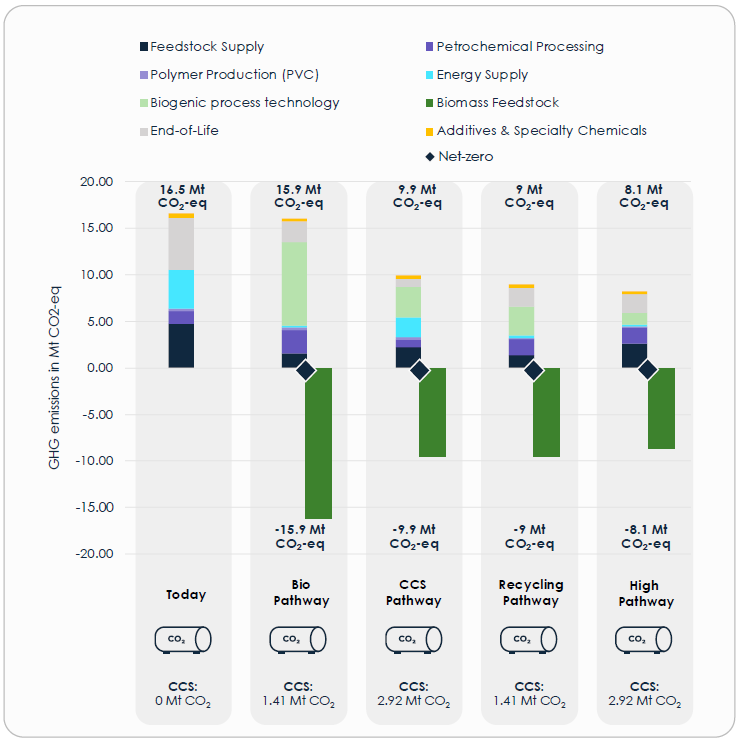
Net-zero PVC is technically feasible by 2050, but there is no single route. Progress depends on a combination of recycling, low-emission energy, renewable and circular carbon, and targeted carbon management.
VinylPlus’ work with Carbon Minds modelled different pathways for reducing climate and water impacts across the PVC value chain, helping identify the technologies, resources and enabling conditions needed for the transition.
Bio Pathway: Higher access to sustainable biomass helps reduce fossil feedstock dependency.
CCS Pathway: Higher access to carbon capture and storage supports management of residual emissions.
Recycling Pathway: Higher recycling availability reduces virgin feedstock demand and end-of-life burdens.
High Pathway: Greater access to several enabling levers creates broader flexibility for decarbonisation.

Water and Environmental Footprint
Decarbonisation should not shift environmental burdens elsewhere. VinylPlus’ work with Carbon Minds therefore considers water deprivation impacts alongside greenhouse-gas emissions.
The pathway analysis shows that water-deprivation impacts can remain broadly comparable to today across the assessed net-zero pathways. Recycling-focused pathways show the strongest potential to reduce water impacts, because higher recycling lowers demand for primary feedstocks, reduces energy use and limits end-of-life burdens.
This underlines the importance of assessing climate, water and circularity together. A lower-carbon PVC value chain will depend not only on renewable energy and feedstock changes, but also on strong recycling systems, efficient resource use and careful management of environmental impacts across the full life cycle.